
ABCCDE of Antihypertensive Drugs: Classification, Mechanism & Examples
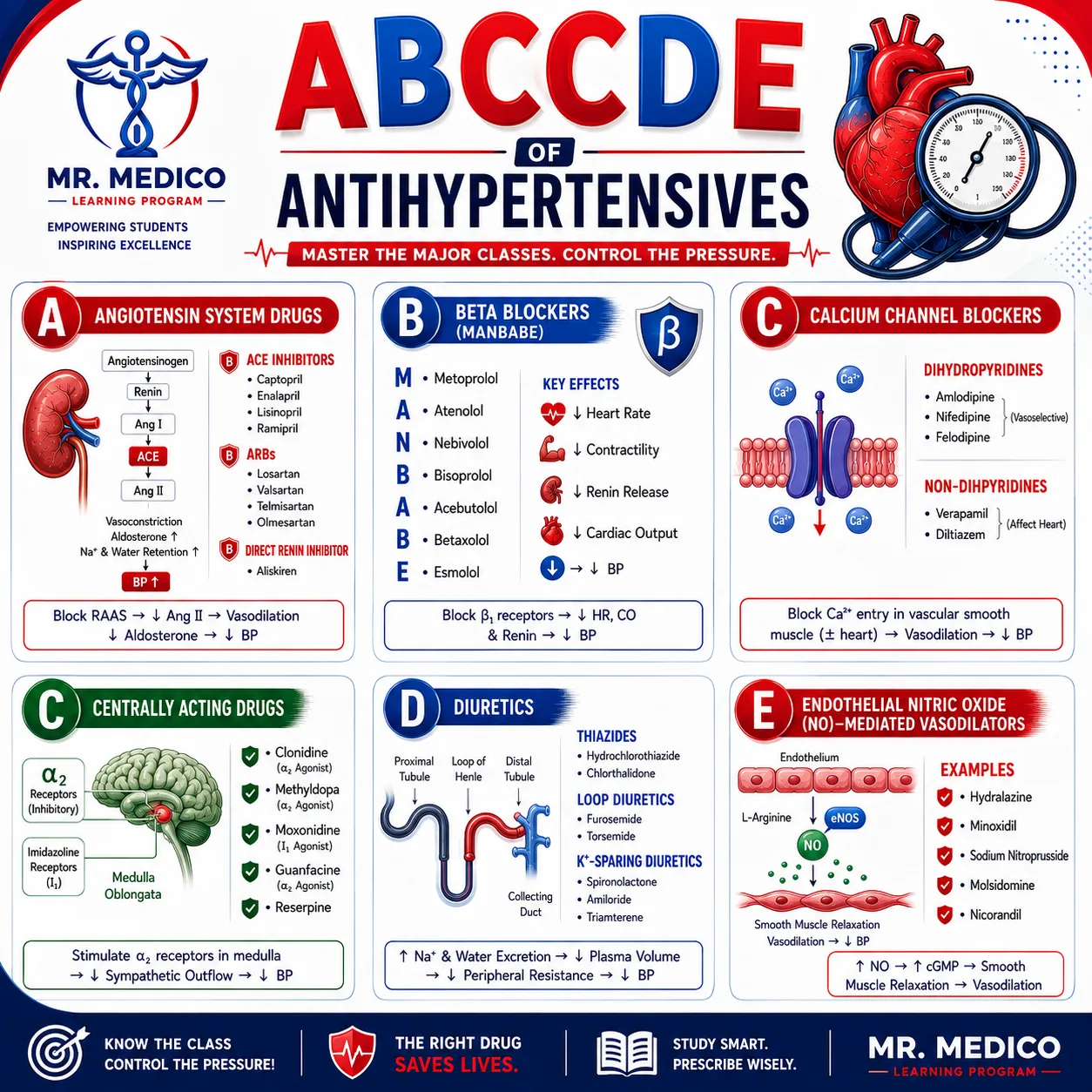
ABCCDE of Antihypertensive Drugs: A Simple Pharmacology Guide
Hypertension is one of the most important cardiovascular conditions encountered in clinical practice. A wide range of antihypertensive drugs is available, and understanding their classification and mechanisms of action is essential for pharmacy and medical students.
To make antihypertensive pharmacology easier to remember, Mr. Medico Learning Program presents the ABCCDE mnemonic, covering six important groups of antihypertensive drugs.
A – Angiotensin System Drugs
Angiotensin system drugs act mainly by interfering with the Renin-Angiotensin-Aldosterone System (RAAS), an important regulator of blood pressure and fluid balance.
Major groups include:
• ACE Inhibitors: Captopril, Enalapril, Lisinopril, Ramipril
• Angiotensin II Receptor Blockers (ARBs): Losartan, Valsartan, Telmisartan, Olmesartan
• Direct Renin Inhibitor: Aliskiren
These drugs reduce the effects of angiotensin II and/or aldosterone. The resulting reduction in vasoconstriction and sodium and water retention contributes to a reduction in blood pressure.
B – Beta Blockers
Beta blockers reduce blood pressure primarily by blocking beta-adrenergic receptors. Cardioselective beta blockers predominantly block β₁ receptors in the heart and kidney.
A useful mnemonic for remembering important beta blockers is MANBABE:
M – Metoprolol
A – Atenolol
N – Nebivolol
B – Bisoprolol
A – Acebutolol
B – Betaxolol
E – Esmolol
β₁-receptor blockade decreases heart rate and myocardial contractility and also reduces renin release from the kidney. These effects contribute to lowering blood pressure.
C – Calcium Channel Blockers
Calcium channel blockers inhibit L-type calcium channels. Their effects depend on the specific drug and tissue targeted.
They are commonly divided into:
Dihydropyridines: Amlodipine, Nifedipine, Felodipine
Non-dihydropyridines: Verapamil, Diltiazem
Dihydropyridine calcium channel blockers primarily cause relaxation of vascular smooth muscle, producing vasodilation and a reduction in peripheral vascular resistance.
Verapamil and diltiazem have more prominent effects on the heart, including reduction of heart rate, conduction, and contractility.
C – Centrally Acting Antihypertensive Drugs
Centrally acting antihypertensive drugs reduce sympathetic nervous system activity from the central nervous system.
Important examples include:
• Clonidine – α₂-adrenoceptor agonist
• Methyldopa – centrally acting α₂-adrenoceptor agonist through its active metabolite
• Guanfacine – α₂-adrenoceptor agonist
• Moxonidine – imidazoline I₁ receptor agonist
These drugs reduce sympathetic outflow from the brainstem. This can decrease peripheral vascular resistance, heart rate, and renin release, ultimately lowering blood pressure.
D – Diuretics
Diuretics lower blood pressure by increasing renal excretion of sodium and water. This initially reduces plasma volume and cardiac output. With continued treatment, reductions in peripheral vascular resistance also contribute to the antihypertensive effect.
Major groups include:
Thiazide and thiazide-like diuretics: Hydrochlorothiazide, Chlorthalidone
Loop diuretics: Furosemide, Torsemide
Potassium-sparing diuretics: Amiloride, Triamterene
Aldosterone antagonists: Spironolactone
Thiazide-type diuretics are particularly important in the long-term treatment of hypertension, while loop diuretics are generally more important when significant fluid overload or reduced renal function is present.
E – Vasodilators and Nitric Oxide-Mediated Vasodilators
Vasodilator drugs reduce blood pressure by relaxing vascular smooth muscle and decreasing vascular resistance.
A key nitric oxide pathway is:
NO → Activation of guanylyl cyclase → ↑ cGMP → Smooth muscle relaxation → Vasodilation → ↓ Blood Pressure
Sodium nitroprusside is an important nitric oxide donor that produces rapid vasodilation and is used intravenously in selected acute hypertensive situations.
Other direct vasodilators, such as hydralazine and minoxidil, also lower blood pressure by relaxing vascular smooth muscle, but their mechanisms are different from classical nitric oxide donors. Hydralazine has a complex mechanism that is not completely established, while minoxidil primarily opens ATP-sensitive potassium channels.
ABCCDE: Quick Revision
A – Angiotensin System Drugs
B – Beta Blockers
C – Calcium Channel Blockers
C – Centrally Acting Drugs
D – Diuretics
E – Vasodilators / NO-Mediated Vasodilators
Why Is the ABCCDE Mnemonic Useful?
The ABCCDE mnemonic provides a structured way to recall major antihypertensive drug classes during pharmacology revision. It can be particularly useful for MCQs, viva preparation, university examinations, and quick revision before clinical pharmacology assessments.
However, memorizing drug classes alone is not enough. Students should also understand the mechanism of action, major examples, therapeutic uses, adverse effects, contraindications, and important drug interactions associated with each class.
Key Takeaway
The easiest way to approach antihypertensive pharmacology is to connect every drug class with its primary physiological target:
RAAS → β₁ receptors → Ca²⁺ channels → Central sympathetic activity → Renal sodium/water excretion → Vascular smooth muscle relaxation
Once these mechanisms are connected, antihypertensive drug classification becomes much easier to understand and remember.
Study smart. Understand the mechanism. Master pharmacology.
Mr. Medico Learning Program Empowering Students | Inspiring Excellence